
Warrants in Macomb County
Warrants in Macomb County come from two main places. A judge or magistrate signs them, and the reason splits along two lines. One is a charge warrant. The other is a bench warrant. A charge warrant follows a police investigation and a prosecutor's decision to authorize charges. A bench warrant comes from inside a case, often after someone skips a court date or ignores a court order. Both are court orders that can lead to an arrest.
No official website posts a public list of every active warrant in the county. The Sheriff's Office does not publish a searchable warrant roster in the sources located for this county. That gap changes how a search works. Instead of one lookup, a person checks the court case systems, the jail roster, and the office that issued the order. The elected prosecutor decides which criminal charges move forward, and that decision starts the paper trail that a court later tracks.
The Macomb County Prosecutor's Office represents the people of the State of Michigan in felony, misdemeanor, and juvenile matters. Its homepage lays out that role and the units that pursue charges.
That office is where the warrant story begins, because prosecutors, not police alone, decide when a criminal charge and its warrant get authorized. Understanding that order of events explains why an arrest may not appear as a full court case right away.
Where to Check for a Macomb County Warrant
Because no single warrant portal exists, a search runs through several official channels. Each one holds a different slice of the record. Public case systems show warrants that already appear as docket events in an open case. The jail roster shows warrant data when a person is already booked. The issuing court holds everything else. Working the list in order gives the best chance of a clear answer without guessing.
- CourtView / eServices - Search Circuit Court and Probate Court cases at courtpa.macombgov.org/eservices; a warrant may show as a docket event on a public case.
- MiCOURT Case Search - Use the statewide portal at micourt.courts.michigan.gov for participating district courts where bench warrants often arise.
- JailTracker roster - If the person is in custody, the Macomb County JailTracker profile lists warrant number, case number, and bond data.
- Issuing court clerk - Call the district court that named the case or the Circuit Court clerk to confirm a warrant, bond, and next appearance.
- Sheriff's Office - Reach the Macomb County Sheriff's Office at 586-469-5151 for custody questions and arrest execution.
These channels overlap, so a warrant found in one may be confirmed in another. A felony case that reaches Circuit Court usually appears in CourtView. A traffic or misdemeanor bench warrant is more likely to live in a district court file reached through MiCOURT. When a public lookup returns nothing, the phone call to the clerk is the reliable fallback.
The Macomb County Prosecutor's Warrant Division
The Warrant Division is the office that authorizes criminal charges in Macomb County. Assistant prosecuting attorneys staff it, and they review thousands of criminal investigations each year. Those cases arrive from 23 independent police agencies across the county. The division reads each investigation and decides what charges, if any, should be issued. Police make arrests and gather evidence, but the charging call rests with the prosecutor.
When charges are appropriate, the division prepares a criminal complaint and a warrant authorizing those charges. That paperwork goes back to the police agency to start the prosecution. This is the local reason a warrant and an arrest do not always match a public court case on day one. The complaint and warrant may exist before the case fully opens in a court's public docket. The Prosecutor's Warrant Division page explains this authorization step in plain terms.
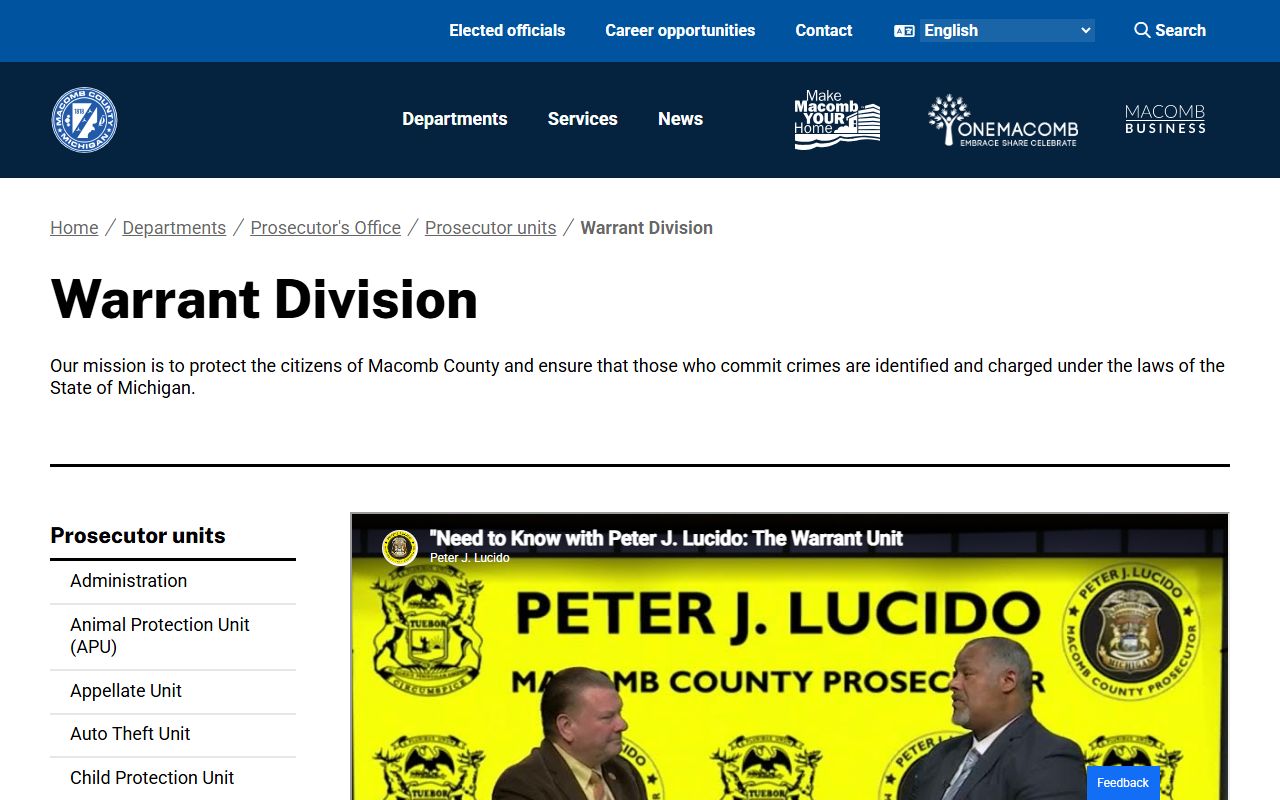
That page is the key official source for how charge warrants come to life in the county. It also frames why the court record, not the police report, becomes the tracking file once charges are filed.
Peter J. Lucido serves as the Macomb County Prosecutor and the county's chief law enforcement officer. He directs the assistant prosecuting attorneys, crime-victim advocates, and support staff who carry out the office's charging and trial work. The office biography of Prosecutor Lucido outlines that role.
The prosecutor's decisions set the direction for felony and serious misdemeanor cases countywide. A warrant authorized here is the front end of a case that the courts and clerk then record.
Bench Warrants in Macomb County District Courts
Many everyday warrants are bench warrants from the district courts. A judge issues a bench warrant when a person fails to appear, skips a payment plan, or ignores a court order. Traffic cases, misdemeanor cases, and the preliminary stage of felony cases all run through the district courts first. A missed hearing in any of them can trigger a warrant. These warrants usually follow the city or township court that named the case, not the county Circuit Court.
Macomb County has ten district court destinations spread across its communities. The 37th District Court serves Warren and Center Line. The 41B District Court covers Clinton Township, Harrison Township, and Mount Clemens at 22380 Starks Drive. The 42-1 court in Romeo and the 42-2 court in New Baltimore serve the northern townships. Because each court holds its own files, a warrant check starts with the court printed on the ticket or the charging paper.
The official Nearby Courts list names every Macomb district court and links to each one. Several of those courts route case lookups to MiCOURT Case Search. One important limit applies. Nonpublic records are not reachable through the portal, and some courts allow only the defendant to view them in person. The full criminal case behind a warrant is covered on the Macomb County criminal court records page.
Macomb County Warrant Search Fields
When a person is already booked into the county jail, the JailTracker roster is the practical way to confirm a warrant. It is not a standalone warrant search, but a booked profile carries warrant and bond data. The public search screen uses a small set of fields. Name is the primary way in, and a captcha may appear before results load. The field layout below reflects the roster application used for Macomb County custody records.
| Field Label | Type | Required | Notes |
|---|---|---|---|
| Last Name | Text | Yes | Primary search field for a name lookup. |
| First Name | Text | No | Narrows a common last-name match. |
| Search Type | Dropdown | No | Selects how the roster is queried. |
| Agency | Dropdown | No | Filters by the booking or holding agency. |
| Released Since | Filter | No | Limits results to recent releases. |
| Captcha Code | Image / Text | Yes when shown | Must be entered to run the search. |
The roster loads inside a browser application, so fields can shift by view. Access it from the Sheriff's locate an inmate page. If a person is not in custody, this tool will not show an outstanding warrant on its own, and the court channels remain the better route.
What a Macomb County Warrant Record Shows
A warrant record pulls together details from the prosecutor, the court, and the jail. The exact fields depend on where the record is viewed. A booked profile in JailTracker shows the most warrant-specific data, while a public case docket shows the court side. The list below reflects the fields drawn from official prosecutor, court, and jail sources for this county.
| Field | What It Shows |
|---|---|
| Warrant Number | The identifier assigned when a person is booked on the warrant. |
| Case Number | The court case tied to the charge, once one is filed. |
| Charge Description | The offense the complaint and warrant authorize. |
| Arresting Agency | Which of the county police agencies made the arrest. |
| Bond Amount / Type | The amount and form of bond set for release. |
| Court Date / Time | The next scheduled appearance where required. |
| Charge Status | The current stage of the charge in the process. |
| Issuing Court | The district, circuit, or probate court behind the order. |
Not every field is public in every case. Sealed warrants, juvenile warrants, and investigative search warrants stay out of public view. A defendant who needs certified detail should work through the court clerk rather than a screen printout, since a public lookup is not the official record.
How to Resolve an Outstanding Warrant
An outstanding warrant does not clear itself. Ignoring it usually makes things worse, and it can turn a routine traffic stop into an arrest. The steps below follow the channels the county actually uses, from finding the issuing court to confirming that the warrant is cleared. Legal advice matters here, so read the callout before acting on your own.
- Identify the issuing court or agency: a district court for traffic, misdemeanor, failure-to-appear, or preliminary felony matters; the Circuit Court for post-bindover felony or probation issues; Friend of the Court for support enforcement.
- Search CourtView or MiCOURT if a public case already exists.
- Call the court clerk before appearing to confirm bond, appearance details, and whether counsel should file a motion.
- If already in custody, use JailTracker and the bond page to gather the inmate name, inmate number, case numbers, and bond or fine amount.
- Post bond at the court during court hours where required; after hours, the Sheriff's Office handles certain bond payments except Circuit Court and Friend of the Court cases.
- Keep every receipt and confirm the court clears the warrant or updates the case.
Important: Talk to a lawyer before you turn yourself in on any warrant, since counsel can arrange bond, file a motion, and protect your rights during the appearance.
People who cannot afford a lawyer may qualify for appointed counsel. The Macomb County Office of Public Defender, led by Erin Freers-Cole, manages the county's indigent criminal defense system for eligible adults.
That office assigns counsel in felony cases and, under recent agreements, in certain county-funded district courts. Early legal help can shape how a warrant appearance and any bond are handled.
Posting Bond After a Macomb County Arrest
Bond is money or conditions that secure a person's return to court. In Macomb County, where you post it depends on the case and the time of day. During court hours, most bonds are posted at the court, though Circuit Court and Friend of the Court cases follow their own path. Outside those hours, bonds can be paid at the Sheriff's Office. The Pay Bonds page lays out the procedure and the details a payer needs to have ready.
Before paying, gather the inmate name, the inmate number, the case numbers tied to the charges, and the bond or fine amount. Check the inmate locator first to confirm those details. In-person jail payments accept cash, a cashier's check made out to "Macomb County Prisoner Information," and major credit cards with a fee, along with surety bonds through licensed agents. Online and phone bond payments run through Government Payment Services. The bond phone line is 586-307-9612.
Release is not instant. The Sheriff's Office says it can take several hours depending on jail activity and where the person is housed. Warrant and bond fields also appear on the county inmate roster for anyone already booked.
Note: The Sheriff's Office warns that it will never call to demand money, gift cards, bitcoin, or other payment by phone, so treat any such call as a scam and dial 586-469-5151 to confirm.
Restricted Macomb County Warrant Records
Not all warrants are open to the public. State law and court rules keep several categories out of public search. Juvenile warrants sit with the Juvenile Division and are limited by statute. Sealed warrants and investigative search warrants stay confidential to protect ongoing work. Records tied to set-aside convictions can be made nonpublic after a court grants relief, and a public case lookup will not reveal them.
District courts add their own limit. The 37th District Court notes that nonpublic records cannot be reached through the online portal and can be viewed only by the defendant, in person, at the court. That rule reflects Michigan's broader framework, where court records are public only to the extent allowed by court rule, statute, and court order. Federal warrants are handled through the U.S. District Court for the Eastern District of Michigan, which is separate from the county system.
For records that are public but not online, the reliable route stays the same. Call the court clerk, confirm what can be released, and request certified copies where a legal proceeding requires them. The charges behind a warrant are also traced on the Macomb County arrest records and charges page.