
How to Search Macomb County Traffic Court Records
Macomb County has no single traffic court. Each ticket is filed with the district court for the city or township where it was issued. The name of that court is printed on the citation. Once the court is known, most cases can be viewed through the statewide MiCOURT Case Search or the individual court's own site. The county's Nearby Courts page links every Macomb district court in one place. What appears online depends on the court and the case type.
A few details make the lookup faster. Have the citation or ticket number ready first. The driver name and date of birth help narrow a name search. The issue date and offense type are needed for many payment tools. The fields below are the ones Macomb district court search and payment systems commonly request.
| Field Label | Type | Required | Notes / Format |
|---|---|---|---|
| Court | Dropdown / selector | Yes | Pick the Macomb district court in MiCOURT or the local payment tool. |
| Case or ticket number | Text | Yes to pay, optional to search | The 41-B payment tool requires the court case or ticket number and date issued. |
| Date issued | Date | Required for some tools | Required by 41-B CivPay instructions. |
| Type of offense | Text / dropdown | Required to pay | Required by 41-B instructions. |
| Total amount owed | Currency | Required to pay | Required by 41-B instructions. |
| Name | Text | Optional / conditional | Used in case-search views; required status varies by court. |
Note: MiCOURT results are for informational use only and do not replace the official record on file with the district court.
Which Courts Handle Traffic Cases in Macomb County
District courts carry the traffic docket in Michigan. In Macomb County, ten district-court destinations cover the cities and townships. A ticket follows the community where it was written, not the county Circuit Court in Mount Clemens. The 42-1 District Court states its jurisdiction covers parking, traffic, and other civil infractions along with criminal misdemeanors, small claims, and landlord-tenant matters.
Knowing the right court saves time and prevents a missed deadline. Some courts share a number but sit in different cities. The 37th District Court, for example, has two locations, while the 41-A and 42nd courts each serve several communities. The list below maps the main Macomb district courts to the areas they serve.
- 37th District Court - Warren and Center Line, with a courthouse in each city.
- 38th District Court - Eastpointe, at 16101 Nine Mile Road, Eastpointe.
- 39th and 39-B District Courts - Roseville and Fraser.
- 40th District Court - St. Clair Shores.
- 41-A District Court - Shelby Township, Macomb Township, Utica, and Sterling Heights.
- 41-B District Court - Clinton Township, Harrison Township, and Mount Clemens, at 22380 Starks Drive.
- 42nd District Court - Romeo (42-1) and New Baltimore (42-2), serving the northern communities.
What Macomb County Traffic Court Records Show
A traffic court record is the case file the district court keeps for a citation. It starts when the ticket is filed and grows as the case moves along. The record ties the citation to a case number, the charge, and the driver. It then tracks every court date and every payment. The final entry is the disposition, which is the outcome of the charge.
Disposition matters more than any other field. A guilty finding, a plea, a dismissal, or an admission each reads differently on the record. Fines and costs appear next to the outcome. Where public, warrant or failure-to-appear activity shows as well. The common fields are set out below.
| Field | What It Shows |
|---|---|
| Citation / Ticket Number | The number the officer wrote on the citation. |
| Case Number | The court file number assigned when the ticket was filed. |
| Violation / Charge | The traffic offense and the statute or ordinance cited. |
| Court Date | Scheduled hearing, arraignment, or informal review date. |
| Plea or Contest Activity | Whether the driver admitted, denied, or asked for a hearing. |
| Disposition | The final outcome, such as responsible, dismissed, or reduced. |
| Fines and Costs | Amount assessed and current payment status. |
| Judge or Magistrate | The judicial officer who handled the case. |
Types of Traffic Cases on Record
Not every ticket is the same kind of case. Most are civil infractions, which are not crimes and carry no jail time. Others are misdemeanor traffic offenses, which are criminal and can carry jail, probation, and a criminal record. Parking and equipment tickets sit lower still. The district court that serves the community handles all of these.
The category controls how a case is answered and what it does to a driving record. Civil infractions can often be paid or reviewed informally. Misdemeanor traffic charges usually require a court appearance. The main types found on Macomb district-court records are listed here.
- Moving violations - Speeding, disobeying a signal, and similar civil infractions.
- Non-moving and equipment - Registration, insurance, and vehicle equipment tickets.
- Parking - Local parking citations handled by the district court.
- Misdemeanor traffic - Driving on a suspended license, reckless driving, and other criminal traffic charges.
- Commercial vehicle and CDL - Violations tied to commercial driving, with stricter handling.
- Juvenile traffic - Cases involving minors, handled through the Juvenile Division and generally restricted.
Searching by Citation Number vs by Name
Two paths lead to the same case. A citation or case number is the surest way in. It points to one record and skips the guesswork. Type it exactly as printed, since a wrong digit returns nothing. Many payment tools accept only the ticket or case number.
A name search casts a wider net. It helps when the ticket is lost or the number is unclear. The trade-off is common names, which can return several matches. Adding a date of birth narrows the results where the court allows it. Some district-court records are nonpublic and open only to the defendant in person at the court, so a name search will not surface everything.
Note: nonpublic district-court records are not available through MiCOURT and can be viewed only by the defendant in person at the court.
Paying or Contesting a Macomb County Traffic Ticket
Each district court sets its own payment channels. The 41-B District Court uses CivPay for online ticket payment and asks for the case or ticket number, issue date, offense type, and total owed. The 38th District Court routes online payers to DivDat and accepts pay-by-mail with a check or money order, no cash, and the back of the citation signed. Mailed payments to the 38th go to 16101 Nine Mile Road, Eastpointe. Always confirm the deadline printed on the ticket.
Contesting works differently. A driver can admit responsibility, deny it, or ask for a hearing. Some courts offer an informal review instead of a full hearing. The 41-B District Court posts a Court Innovations online review link for traffic tickets. To contest, contact the district court named on the citation and follow its instructions. The steps below outline the full path from citation to resolution.
- Identify the court named on the citation using the city or township and the district-court list.
- Search MiCOURT or the local district court site for the case or ticket if it appears online.
- To pay, use the court-approved tool such as CivPay for 41-B or DivDat for the 38th, with the ticket or case number ready.
- To mail payment, follow that court's rule; the 38th requires a check or money order and a signed citation.
- To contest, contact the district court or use its online review program where one is offered.
- Request a copy from the district court clerk if the online record is informational only.
Miss a date or a payment. A missed court date or unpaid ticket can trigger a bench warrant or a license consequence, so check with the district court and not the sheriff site alone.
Court Traffic Records vs State Driver Records
Two separate files exist for every driver. The court traffic record is the case file at the district court where the ticket was written. The state driver record is a different file kept by the Michigan Secretary of State. One shows the case; the other shows the license. Confusing the two leads to wrong assumptions about points and status.
Convictions flow from the court to the state, not the other way around. When a district court enters a disposition, it reports the result, and the state applies points and license actions. To read a full picture, a driver may need to check both. The table compares the two files.
| Aspect | Court Traffic Record | State Driver Record |
|---|---|---|
| Record source | The district court where the citation was filed. | The Michigan Secretary of State driver-record system. |
| What it shows | Citation and case number, violation, court date, plea, disposition, fines, costs, and payment status. | License status, points, suspensions, and convictions reported by courts. |
| Where to access | MiCOURT or the local district court and its clerk. | Through the Michigan Secretary of State driver-record channels. |
| How to correct errors | Contact the district court clerk that holds the case file. | Contact the Secretary of State; court reports drive most entries. |
Public Access Laws for Traffic Court Records
Michigan treats court records as open unless a rule, statute, or order restricts them. Traffic case files follow the same framework as other district-court records. The court-maintained tools are the first stop, not a general records request. For traffic matters that means MiCOURT or the district court itself, since those are the systems that publish the case.
Some material stays out of public view. Juvenile traffic, sealed cases, and personal identifiers may be withheld or redacted. Nonpublic records are reachable only by the defendant in person at the court. The statutes and rules below set the ground rules.
Key rules and statutes:
Michigan Court Rule 8.119 - governs how courts keep records and when the public may access them.
Michigan Court Rule 1.109 - defines court records as information created by or filed with a court.
DUI and Impaired Driving Cases
Drunk-driving cases are not ordinary traffic infractions. In Michigan the charge is often called OWI, operating while intoxicated, and it is criminal. A first case usually starts at the district court, and serious or repeat cases can move to the Circuit Court. These files carry pleas, sentencing, and probation terms that a simple ticket does not. Macomb County also runs a DWI and Sobriety treatment court for eligible drivers.
Because the charge is criminal, the record sits with the criminal case file rather than the civil traffic docket. For charges, hearings, and sentencing detail, see Macomb County criminal court records.
CDL and Commercial Driver Records
Commercial drivers face tighter rules on any citation. A CDL holder is judged against federal safety standards, so a violation that seems minor can carry serious license effects. Many programs that reduce or mask a conviction for other drivers are not open to commercial drivers. Convictions are reported and can reach the driver's federal record.
For that reason a CDL holder should read a traffic ticket carefully before paying it. Paying a citation is an admission of responsibility. That admission can post to the driving record and affect a livelihood behind the wheel. When the stakes are high, contacting the district court or an attorney before responding is the safer path.
Note: paying a Macomb County traffic ticket is an admission of responsibility, and for CDL holders that admission can carry heavier license and employment consequences.
Online Review and Defensive Driving Options
Some Macomb district courts offer alternatives to a formal hearing. An informal or online review lets a driver explain the citation without a full trial. The 41-B District Court posts a Court Innovations online review link for traffic tickets, which handles the request over the internet. Availability and any deferral of a violation vary by court and by offense.
These programs do not apply to every ticket or every driver. The rules differ across the ten Macomb district courts, and not all publish the same options. The court named on the citation is the authority on what it offers. Confirm eligibility and cost directly with that court before assuming a review is available.
Setting Aside Macomb County Traffic Convictions
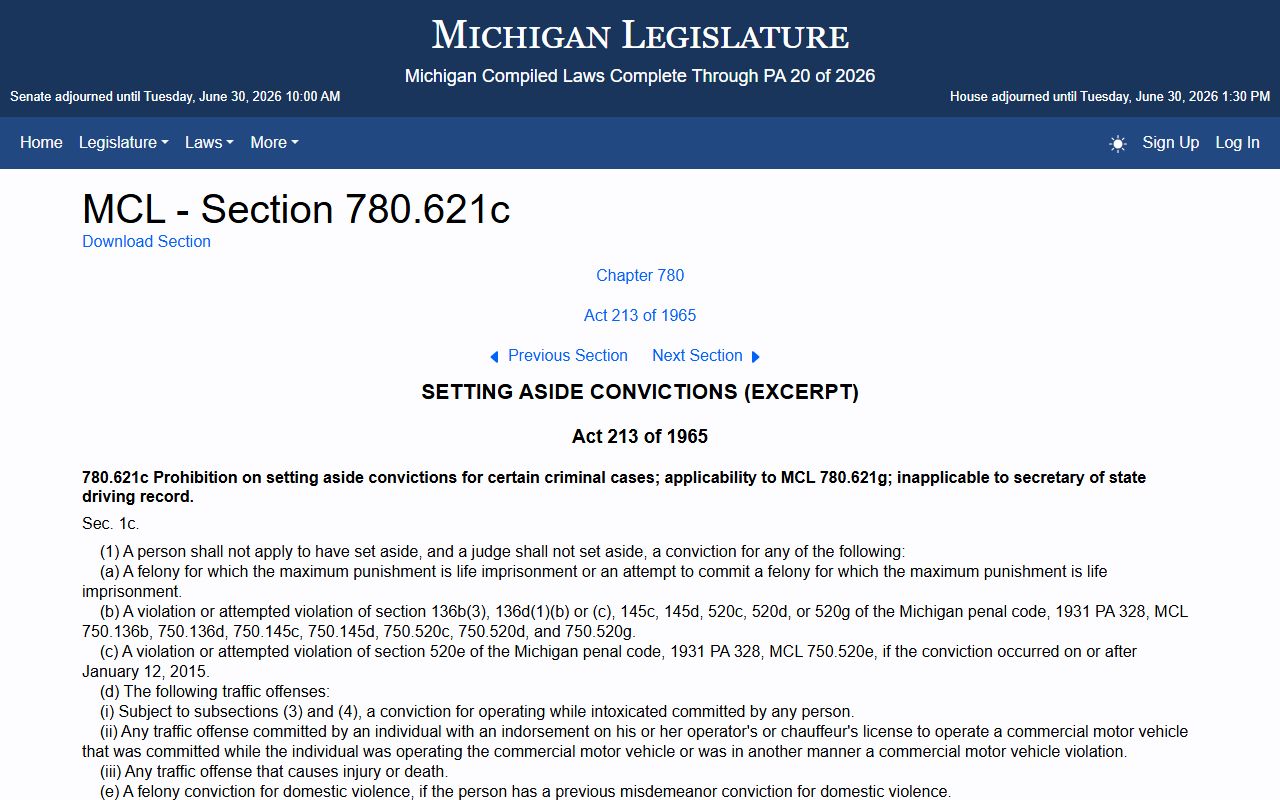
Michigan uses the term set aside for clearing a conviction from public view. Traffic offenses have their own treatment under state law. A dedicated statute limits how a set-aside applies to traffic convictions and how they are handled afterward. The statute is the starting reference for anyone weighing this route.
The controlling law is set out in the Michigan traffic set-aside statute, MCL 780.621c, which addresses set-aside orders for traffic offenses. The image below links to the official statute text.
Most applicants use SCAO form MC 227, Application to Set Aside Conviction, filed with the court that entered the conviction. The general Michigan set-aside statute, MCL 780.621, sets the waiting periods and conditions. A court cannot rule until the required Michigan State Police report is received. Eligibility rules are strict, so read the statute and form before filing.
Traffic Citations on Federal Property
A small share of citations do not belong in a district court at all. A ticket written on federal property, such as a military installation or a federal facility, is a federal matter. Those cases route to the U.S. District Court for the Eastern District of Michigan, which covers Macomb County. The federal court handles its own docket separate from any Macomb district court.
Details on the federal court sit on the U.S. District Court, Eastern District of Michigan site. The image below links to that court's homepage.
Public access to federal dockets runs through PACER, the electronic case system for federal courts. The PACER Eastern District of Michigan lookup shown below points to the court's electronic records. For most Macomb traffic tickets this path never applies, but a federal-property citation is the exception to keep in mind.
Requesting Copies of Traffic Records
Online case views are informational, so a certified copy comes from the court itself. For a district-court traffic case, the district court clerk that holds the file provides the copy. Fees and formats vary by court, so confirm the amount with the specific court before sending payment. The clerk can supply a certified disposition for insurance, employment, or legal needs.
Wider requests follow other channels. The Macomb County Clerk handles Circuit Court file-room orders and links its request tools on the Clerk court-records page, and general court-records help ties into the county's broader Macomb County court records options. For sheriff or county-agency records that are not court case files, Michigan's FOIA procedure under MCL 15.235 applies instead. Court case copies, though, start with the court that holds the case.