
Criminal Court Records in Macomb County
A criminal court record is the official case file opened when charges are filed against a defendant. In Macomb County, the Clerk of the Circuit Court keeps felony case files, while each district court clerk keeps its own misdemeanor and preliminary files. Every document filed with the 16th Judicial Circuit Court is entered on the computer system daily. The file grows as the case moves. It holds the charging document, bond entries, motions, orders, the plea or verdict, the judgment of sentence, and a register of actions that lists each event in order. A charge record on its own is not the full case file. The court record is what ties the charge to its outcome.
Two trial-court levels produce criminal court records in the county. The 16th Judicial Circuit Court in Mount Clemens hears felony cases, some serious misdemeanors, and cases bound over from district court. Michigan's district courts carry the lighter load. They handle misdemeanor prosecutions, traffic misdemeanors, and the felony preliminary stages before a case is sent up. The county lists ten district-court destinations across Warren, Center Line, Eastpointe, Roseville, Fraser, St. Clair Shores, Shelby Township, Sterling Heights, Clinton Township, Romeo, and New Baltimore. A closer look at the charges themselves lives in the Macomb County arrest records and court charges, and every category of case sits in the broader set of Macomb County court records.
How to Search Macomb County Criminal Court Records
The county's CourtView eServices portal is the central public lookup for 16th Judicial Circuit Court and Macomb County Probate Court cases. It draws from the courts' computerized records and is treated as public information, though the county warns that results must be verified against the official file. Circuit criminal cases, including bindovers and felony judgments, show up here. District-court criminal cases follow a separate route through the statewide system.
- Open the CourtView eServices portal from the Clerk or Circuit Court page and accept that it is a public lookup, not the certified record.
- Choose the Case Search route, then search by defendant name or by case number when it is known.
- Narrow the results by court, case type, and filing date to find the right criminal matter.
- Open the case to read the register of actions, hearing dates, plea, disposition, and sentence.
- Order a certified copy from the Clerk's file room when a court-stamped document is needed.
District-court criminal cases take a different path. The statewide MiCOURT Case Search covers participating courts and may return criminal, traffic, civil, and domestic matters depending on the court. Nonpublic files do not appear there. The 37th District Court notes that non-public records can be reached only by the defendant, in person at the court. When the online lookup falls short, call the Clerk's Court Section at 586-469-5351 or use the file room order form for a copy.
Note: CourtView is a public lookup, not the certified record, so any detail should be verified against the official court file before it is relied on.
Stages of a Macomb County Criminal Case
A Macomb County criminal case moves through set stages, and each one leaves a mark in the record. Charges begin with the Prosecutor's Warrant Division, which reviews police investigations from the county's independent agencies and decides whether to authorize a criminal complaint and warrant. Once charges are filed, the court opens the case and the docket starts to fill.
Felony case flow: Charges Filed › District Court Arraignment › Preliminary Examination › Bindover to Circuit Court › Pretrial and Motions › Plea or Trial › Sentencing
Arraignment is the first formal appearance. The defendant hears the charge, and the court sets bond. A felony then gets a preliminary examination in district court, a probable-cause hearing that decides whether the case is bound over to the Circuit Court for trial. Misdemeanors skip the bindover and stay in district court. Pretrial conferences and motions follow, and many cases resolve by plea before they ever reach trial. The record notes each hearing, adjournment, and judge action along the way.
Sentencing closes the case. After a plea or a guilty verdict, the judge imposes the sentence and the clerk enters the judgment of sentence. That document fixes jail or prison time, probation, fines, court costs, and restitution.
What a Macomb County Criminal Court Record Shows
A Macomb County criminal court record is built from standard fields. The Court Finance Department tracks the money side, from fines and costs to restitution and bond forfeitures, while Case Management schedules events and generates notices. The register of actions ties everything together in date order, so a reader can follow the case from the first filing to the last.
| Field | What It Shows |
|---|---|
| Case Number | The segmented Circuit Court file number that identifies the case and its year. |
| Court and Judge | The Circuit or district court, the division, and the assigned judge. |
| Defendant | The accused, captioned as People of the State of Michigan versus the defendant. |
| Charges | Each count, the statute or PACC charge code, and severity as felony or misdemeanor. |
| Bond | The bond amount, bond type, and any conditions of release. |
| Plea | The defendant's formal answer: guilty, not guilty, or no contest. |
| Disposition | The final outcome of each charge in the case. |
| Sentence | Jail or prison term, probation, fines, court costs, and restitution. |
| Register of Actions | The dated list of every filing, hearing, motion, and order. |
Reading Dispositions and Sentences
A disposition is the final outcome of a charge, and the sentence is what follows a conviction. Reading them correctly matters, because one case can end in several different ways. Not every charge produces a conviction, and the record shows the difference in plain terms.
- Guilty plea or verdict: the defendant is convicted and moves to sentencing.
- Not guilty verdict: an acquittal after trial, so the charge does not become a conviction.
- Dismissed: the charge is dropped by the court or the prosecutor.
- No contest, or nolo: the defendant does not admit guilt but accepts the conviction.
- Deferred or diversion: judgment is delayed, and a completed program can end in dismissal.
The sentence sits beside the disposition in the record. It states the jail or prison term, the probation length, and the fines, court costs, and restitution the Court Finance Department collects. Probation conditions appear where they are public. A defendant already serving time may also surface in the county jail roster or the statewide corrections locator, which are tracked outside the case file.
Charges vs. Convictions in Macomb County
Being charged is not the same as being convicted, and a Macomb County criminal court record keeps the two apart. A charge is an accusation the prosecutor files. A conviction is the result of a plea or a guilty verdict. A record can show charges that were later reduced, dismissed, dropped, or that ended in acquittal, so the disposition is where the real outcome lives.
| Charge | Conviction | |
|---|---|---|
| Stage | Accusation | Verdict or plea |
| Burden of Proof | Probable cause | Beyond a reasonable doubt |
| Who Decides | Prosecutor authorizes it | Judge or jury |
| Public Record | Yes | Yes |
| Effect | Case pending or resolved | Basis for sentence and record |
Active warrants are a separate question. They are handled through the county's warrant channels rather than the closed case file, and pending charges may not appear as a full court case until the prosecutor authorizes them.
Public Access to Macomb County Criminal Records
Michigan law treats court files as open unless a rule, statute, or court order restricts them. The Freedom of Information Act states the policy that people are entitled to know about the official acts of public bodies. Court records follow the Michigan Court Rules, which keep case files public except where the law shields them. For copies, the Clerk's file room is the official source, and a certified copy carries the court's seal for use with another agency. FOIA is the right tool for sheriff and county agency records, not the first path for an ordinary court case copy.
Key Statutes:
Michigan FOIA, MCL 15.231 - declares the public's right to information about the official acts of public bodies.
Michigan Court Rule 8.119 - governs how courts maintain case files and grants public access unless restricted.
Sealed vs. Set-Aside Criminal Records
Michigan uses the term set aside for what other states call expungement. A sealed record is hidden from public view but still exists. A set-aside conviction is made nonpublic under state law after the applicant meets the waiting period and the court grants relief. Both remove a case from ordinary public search, but they reach that result in different ways.
| Sealed | Set Aside | |
|---|---|---|
| Visibility | Hidden from public view | Made nonpublic by court order |
| Law Enforcement | Limited access remains | Police and authorized users may still see it |
| Michigan Term | Court seals the file | Conviction is set aside under MCL 780.621 |
| Eligibility | By statute or court order | Waiting period of 3, 5, or 7 years by offense type |
| How to Apply | Motion to the court | Sworn SCAO form with notice to state officials |
The set-aside path has strict steps. An applicant files SCAO form MC 227 with the conviction details, charge code, and case number, chooses the correct waiting period, and serves the prosecutor, Attorney General, and Michigan State Police. The set-aside statute, MCL 780.621, sets who qualifies, and the hearing waits until the State Police report arrives. A separate rule under MCL 780.621c addresses how traffic offenses are treated after a set-aside.
Note: A set-aside does not erase every trace, since law enforcement and some authorized agencies keep limited access to the conviction under Michigan's set-aside law.
Federal Criminal Cases Covering Macomb County
Not every criminal case tied to Macomb County is a county case. Federal crimes are prosecuted in the U.S. District Court for the Eastern District of Michigan, which covers the eastern half of the lower peninsula. Federal dockets and documents are public through separate electronic systems, not through CourtView or MiCOURT.
Attorneys file federal criminal matters through the court's electronic system, shown on the Eastern District of Michigan CM/ECF portal.
Public access to those federal case files runs through PACER, which pulls the same dockets a Macomb County defendant's federal criminal case would generate.
The federal court structure over the region also includes a separate financial court. The U.S. Bankruptcy Court for the Eastern District of Michigan keeps its own docket apart from criminal matters.
It is a distinct court, but it shares the federal electronic filing and PACER access that keep Macomb County residents' federal records public and searchable.
A federal conviction can be appealed, and appeals from the district court go to the U.S. Court of Appeals for the Sixth Circuit.
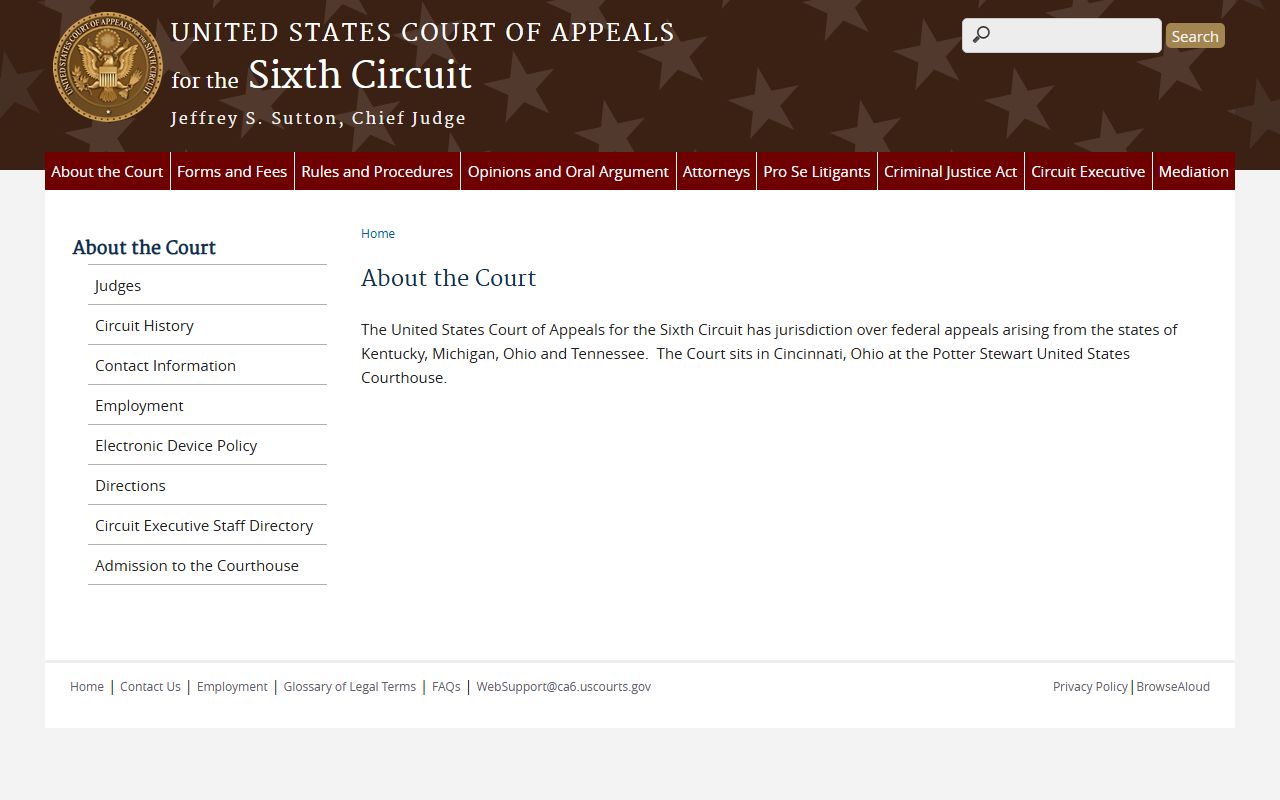
The Sixth Circuit covers Michigan, Ohio, Kentucky, and Tennessee, so a Macomb County federal criminal appeal is decided there rather than in a state court.
Background Check Considerations
Public criminal court records are easy to read one case at a time, but a background check is a different task. A casual lookup pulls a single file. A formal background check compiles cases across courts and must follow federal rules when it is used for hiring, housing, or credit. Certified records from the Clerk are the version accepted for official use. An uncertified screen print from a public portal is not accepted in court or by most agencies.
Important: This site is not a consumer reporting agency under the Fair Credit Reporting Act, and its information may not be used for employment, tenant, credit, or other FCRA-regulated screening.
Restricted Criminal Court Records in Macomb County
Some Macomb County criminal court records stay out of public view. Juvenile matters are handled by the Family Division's Juvenile Division and are not ordinary public files. Adoption and mental-health proceedings are commonly restricted. Sealed and set-aside convictions drop out of public search once relief is granted. Nonpublic district-court records reach only the defendant, in person at the court. Personal identifiers such as Social Security numbers, financial account data, minor names, and victim addresses are redacted before a file is released.
When a record cannot be found online, the file may simply be restricted rather than missing. The Clerk's Court Section can confirm what is public and explain how to request it.
Note: A sealed or juvenile file that does not appear in CourtView is not gone, since access depends on party status, statute, and any court order in place.